SAFA Elects New Vice Presidents as Danny Jordaan Outlines Vision 2030 Roadmap
The South African Football Association (SAFA) ushered in a new chapter of leadership when its National Executive Committee (NEC) convened for an Ordinary Meeting in Sandton, Johannesburg, on Sunday. The gathering marked the first meeting of the newly elected NEC following the successful SAFA Elective Congress held in Midrand on 12 September 2026.
The meeting focused on several key matters affecting the future direction of South African football, including the election of new vice presidents and the establishment of committees tasked with driving the association’s strategic objectives over the next four years.
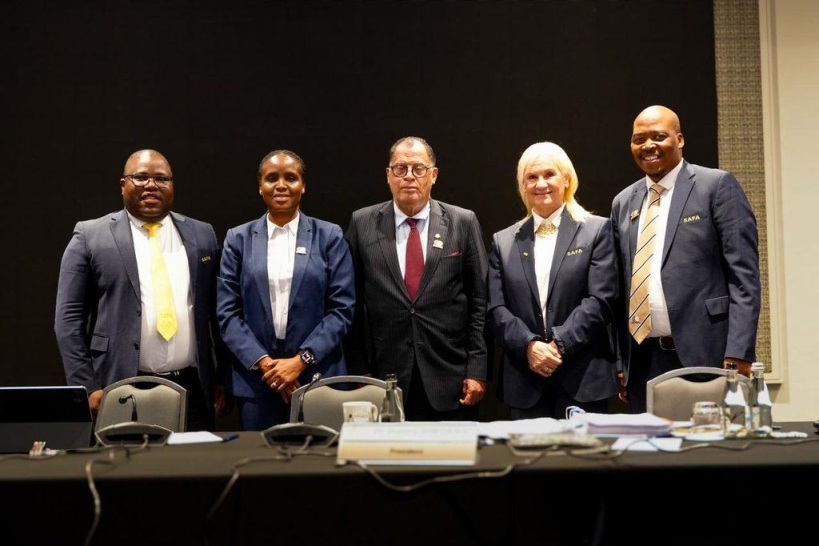
SAFA members elected Anastasia Tsichlas, Linda Zwane and Tankiso Modipa as the association’s three vice presidents. The trio will serve alongside SAFA President Dr Danny Jordaan as the organization seeks to advance its Vision 2030 programme.
Addressing the media after the meeting, Jordaan explained that the election process for the vice presidents differs from the election of NEC members and is conducted from within the executive structure.
“As far as today’s meeting was concerned, the meeting addressed various issues. First, we had to deal with the question of the Vice Presidents we have here at the front table. Now, you know that in the elections at SAFA, you only elect national list members, they are national executive members, and out of those members you then elect the three Vice Presidents arising out of that pool of administrators,” said Jordaan, according to the SAFA website.
The SAFA president also highlighted the experience within the newly elected leadership team, noting the continuity provided by some members and the fresh perspective brought by newcomers.
“We have on my left Mr Linda Zwane, who was a Vice President, served one term and is in his second term as Vice President. We also have Natasha Tsichlas as a Vice President and the new man on the block, Mr Tankiso Modipa sitting next to me,” Jordaan said.
Transparency formed a central theme of the NEC meeting, with Jordaan emphasising that the election process was conducted openly and in full view of all members present.
“The way in which we determined the Vice President is by an open ballot, which was observed by all of the members and as the vote was counted, it was displayed behind us on the screen. So there’s no question that the election showed the transparency and the commitment of SAFA to deal with these matters in an open and transparent way,” he said, as quoted by the SAFA website.
Beyond the election outcomes, the NEC also turned its attention to the association’s long-term development plans. Jordaan stressed that one of the immediate priorities would be refining and implementing Vision 2030, SAFA’s ambitious blueprint for the future of the game.
According to Jordaan, the newly elected vice presidents will work closely with SAFA Chief Executive Officer Lydia Monyepao to ensure that the next phase of the football development programme is effectively executed.
“So the next step is for the Vice Presidents to come together with the CEO (Lydia Monyepao) to put together Vision 2030 which as I said will end in Morocco,” Jordaan said.
He further explained that the strategy encompasses several pillars deemed essential to the growth and sustainability of South African football, from grassroots structures to elite competition.
“In the elements of the Vision 2030, it’s about Schools Football, it’s about Development, it’s about Excellence of our various national teams, it’s about Coaching education and making sure that we have and sustain quality coaches in the country, which is an important issue,” he said.
The NEC also finalised the composition of several committees that will assist in delivering on those objectives. Jordaan confirmed that committees covering Technical, Finance, Schools and Competitions, among others, had been appointed during the meeting.
In addition, members participated in a series of presentations and discussions focusing on Governance, Financial Governance, Leadership, the FIFA Forward Development Programme and Women’s Football. The sessions formed part of SAFA’s efforts to strengthen institutional capacity and align its structures with the broader goals outlined in Vision 2030.
With a refreshed leadership team, renewed governance focus and long-term planning firmly on the agenda, SAFA believes it has laid the foundation for the next phase of South African football’s development journey.