One Ticket, Three Rivals: Why Absolute Group Supremacy is Bafana Bafana’s Only Safe Bet
The road to the 2027 Africa Cup of Nations (AFCON) features a highly unique qualification puzzle, and for Bafana Bafana and the teams trapped in Group D, the margin for error is non-existent. Following the opening round of fixtures on 26 September 2026, the stakes have become crystal clear: securing 1st place is the only guaranteed path to survival. South Africa currently commands the driver’s seat after grinding out a vital 2-1 victory over a resilient Guinea side, putting early points on the board in a group where safety nets do not exist.
As tournament co-hosts, Kenya enjoys automatic qualification for the 2027 finals regardless of their performance in this phase. However, their inclusion in Group D creates a high-stakes, shifting qualification bottleneck for the remaining three nations—South Africa, Eritrea, and Guinea. Because the Harambee Stars are playing without the pressure of elimination, they serve as a dangerous wildcard capable of disrupting the ambitions of rivals who are desperately fighting for every single point.
Only one additional team can escape this group, and the qualification permit depends entirely on where the Harambee Stars finish. This unique regulation means that the traditional safety net of a second-place finish is heavily compromised, forcing the other three contenders to treat every match like a final. Instead of a straightforward top-two race, Group D has effectively been transformed into a cutthroat, winner-takes-all mini-tournament.
The complex math of the group is dictated by two distinct paths. Scenario A dictates that if Kenya finishes in 1st place, the automatic qualification ticket slides down to the team finishing in 2nd place. Conversely, Scenario B presents a much harsher reality: if Kenya finishes anywhere below the top spot, only the 1st-place team will qualify for AFCON, completely eliminating the runner-up from tournament contention.
The Group D rules apply across all three co-host groups (Group H for Uganda and Group L for Tanzania) because the 2027 Africa Cup of Nations will be jointly hosted by Kenya, Uganda, and Tanzania. Branded as the AFCON PAMOJA 2027, this historic tournament marks the first time in CAF history that three countries are co-hosting the prestigious event.
Running from 19 June to 17 July 2027, the tournament brings Africa’s premier football showpiece back to the East African region for the first time since 1976. This shared hosting duty means that just like Group D, both Group H and Group L are transformed into volatile, high-stakes battlegrounds where the traditional runner-up safety net is entirely compromised for the remaining nations.
Kenya’s opening match—a 1-1 draw against Eritrea—proved they will not be handing out easy favors to their continental neighbors. Playing with absolute freedom and fluid attacking intent under the weight of automatic qualification, the Harambee Stars showed they intend to treat these qualifiers as crucial tournament preparation. Their unburdened approach makes them an unpredictable tactical nightmare for managers who must balance aggression with defensive stability.
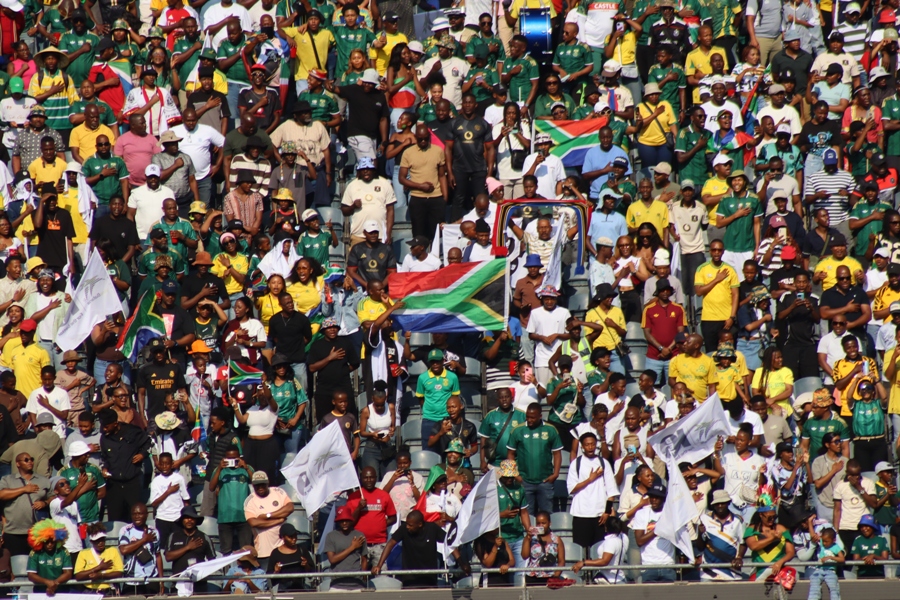
For South Africa, the initial 2-1 triumph over Guinea provides an invaluable psychological edge and a vital three-point cushion. Newly appointed head coach Pitso Mosimane began his highly anticipated second permanent tenure on a perfect note, with goals from Ime Okon and Samukele Kabini delivering the win at Orlando Amstel Arena. The squad displayed immense tactical discipline and grit to absorb late pressure, proving they possess the tournament mentality required to navigate this high-pressure environment.
Guinea, despite their opening-day setback, remains a dangerous powerhouse with the individual quality to turn the group on its head. Their narrow defeat to Bafana Bafana will undoubtedly sharpen their focus, turning their upcoming fixtures into must-win encounters. The Syli National, armed with elite attacking threats like Serhou Guirassy, possess a potent blend of physicality and European-based talent that can dismantle any side if given the space.
Meanwhile, Eritrea enters the qualification fray as the ultimate underdog, a tag that allows them to play with zero external expectations. Their historic 1-1 draw away to Kenya proved they can disrupt the group dynamic completely. While analysts may have dismissed their chances on paper, their defensive resilience and compact structure could easily frustrate the group heavyweights.
The psychological burden on the players in these host-locked groups is unlike any other qualifying campaign in recent memory. Knowing that finishing second could mean absolute elimination forces teams to abandon conservative, draw-oriented tactics in favour of high-intensity, attacking football. Every goal scored and every clean sheet kept will be scrutinised under the microscope of tournament regulations as Bafana Bafana looks to protect their early lead.
With the pressure mounting, the group quickly moves into its next set of crucial fixtures. Eritrea will host South Africa on 30 September 2026 at the Al-Salam Stadium in Cairo, Egypt. Eritrea is playing at this neutral venue because they do not currently possess a stadium that meets the standard infrastructure and hosting requirements set by the Confederation of African Football (CAF).
Following that clash, Guinea and Kenya will face off on Thursday, 1 October 2026, at the Stade du 28 Septembre (28 September Stadium) in Conakry, as the Syli National desperately hunt for their first points of the campaign while the Harambee Stars look to refine their tournament form on the road.